The city of Trinidad was founded in 1514 under the name Villa de la Santísima Trinidad. It has been a UNESCO World Heritage Site since 1988, which is no surprise once you witness how well Trinidad has been preserved.
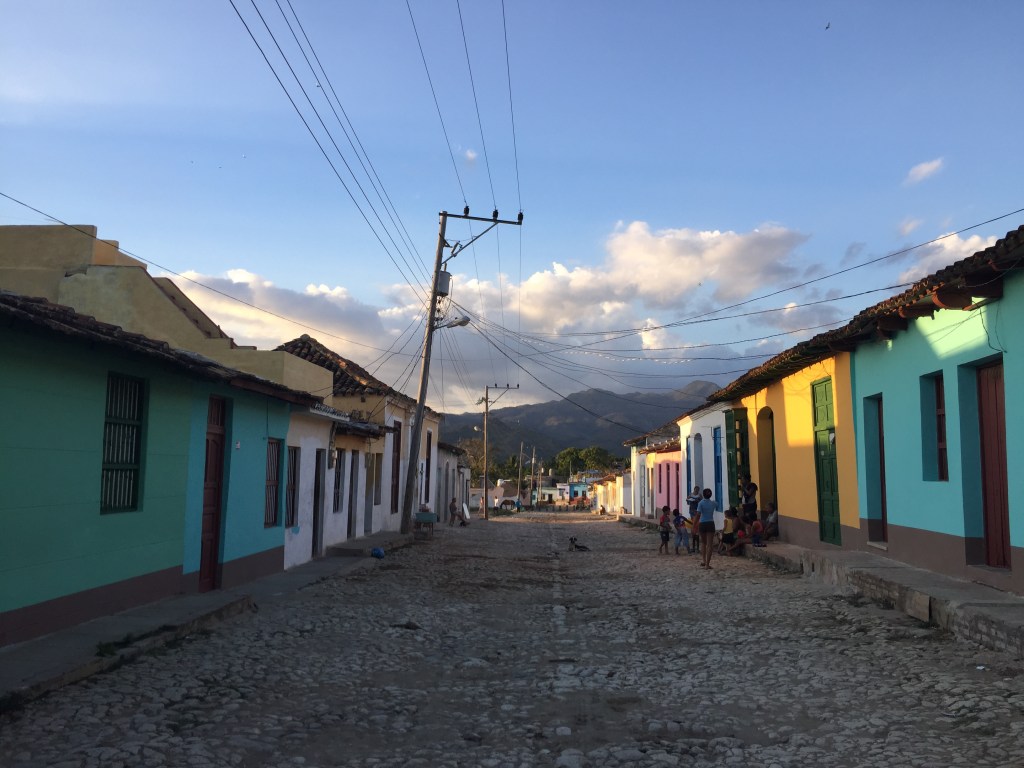
Entering Trinidad is like being thrown back in time to an age long before technology and modernity. It is a city stuck firmly in an old world. As you arrive into the city, the roads turn from cracked tarmac to dirt and cobbled streets. Horses pull carts carrying large of groups of people, as if someone has ordered the archaic version of an Uber XL. The houses have departed little from their original forms, save for the electricity and phone cables that criss cross along the narrow lanes.
While the past has been preserved well in this city, that does not mean that many elements of modernity have crept into everyday life. Loud mopeds and trucks roar through the city reminding you that you are not in fact in an old world but just a well kept representation. Trinidad is also a hotspot for tourism, something I really disliked while I was there. You are approached at almost every corner by someone trying to sell something, who has learnt just enough English (or German) to begin the process of bartering. You can easily get lost in the beauty of Trinidad’s cobbled streets and colourful colonial buildings, but you are immediately brought straight back when a man tries to shove a necklace or pendant in your face asking for an extremely inflated price.
Where I Stayed
All over Cuba you are hosted in Casa Particulars by local Cubans. Trinidad is no different. As recommended by my Casa in Havana, I stayed in Casa Douglas, named after the man who ran the Casa with his lovely wife. Their Casa was located on the upstairs floor of a two storey house. While my first hosts spoke limited English with an ability to understand slowly spoken words, Douglas and his wife understood almost no English whatsoever. This, for me was a challenge, and a welcomed one at that. Coming out to Cuba and South America I wanted to become as fluent as possible in Spanish, and being forced to speak Spanish and only Spanish meant I was thrown into the deep end almost immediately and asked to adapt.
What was so special about his Casa, apart from the great hosts, was that Douglas was a chef before he realised that it was much more profitable to leave that profession. This meant that instead of trawling the streets of Trinidad in search of quality food, Douglas concocted incredible private meals for me and two french girls who were staying there at the same time. We had the largest fresh Lobster I’ve ever seen, and a delicious pasta dish that blew my mind. It was a great addition to an already warm and homely Casa and what I remember as some of my fondest meals.
The Cultural Stuff
Trinidad is rich in culture and historical significance. Physically it is almost unchanged, meaning that walking down any street, especially as you move into central Trinidad is a literal walk down memory lane. Just outside Trinidad there’s an array of walks to explore, especially the nearby Valle de los Ingenios, which is also protected by UNESCO.
The Plaza Mayor
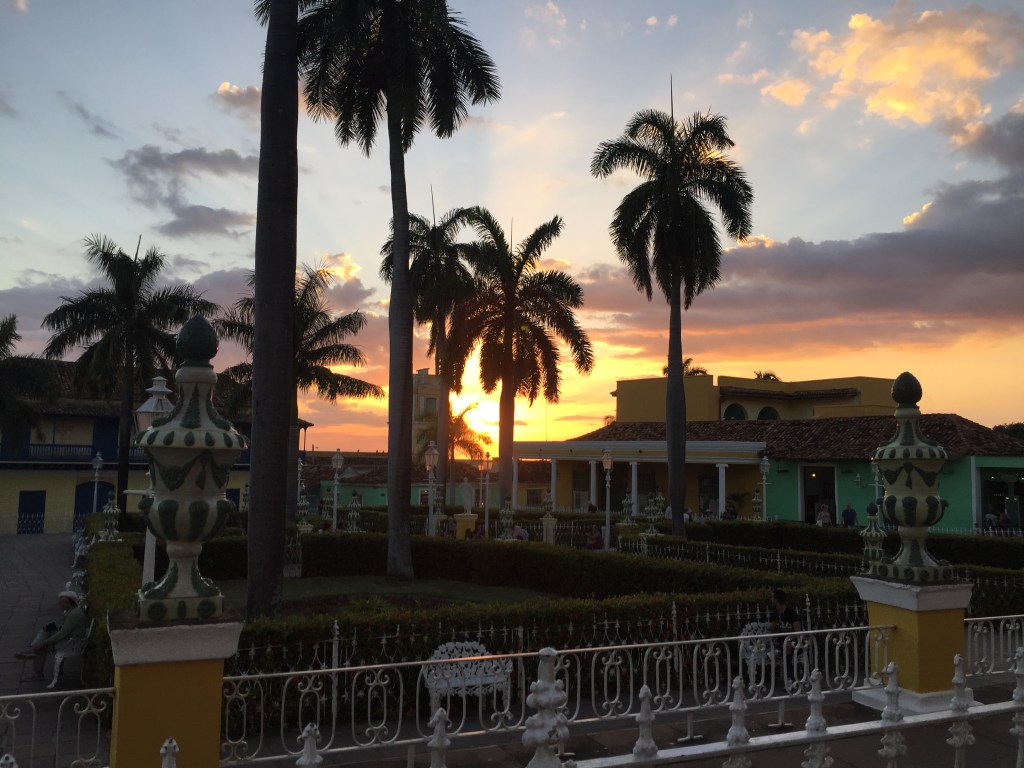
The main Plaza of Trinidad is constantly alive, mostly by the hustle and bustle of tourist groups, and those trying to sell things to said groups. Its main features are a popular Salsa bar that sits right above it and is almost always buzzing apart from the morning hours. Along with that, a well preserved green space and the surrounding pastel coloured buildings. It is a people watching hub and the anchor of the whole town, with almost road leading back into its arms. It is especially special during sunset, when the sun dapples softly and warmly through the large palm trees and onto its busy steps.
Playa Ancon
While the southern coast of Cuba does not compare in any way to Cuba’s famed northern, white sand, crystal blue playas, there is still something to offer down south. Playa Ancon, situated a short taxi ride or a slightly longer and much more exhausting bike ride south of Trinidad, offer a relaxing escape from the busy streets and constant hassle of the city.
Myself and the two French girls chose to cycle there, leaving at the idiotic hour of midday, when the temperature was a stifling 32 degrees and there was no cover whatsoever from the sun. After a brutal cycle we arrived at what turned out to be a large complex of resorts that had divided up the beach into their only plots of land. We payed a small toll and made our way further down the beach away from the hotels. This, in hindsight was not the smartest decision as this part of the beach had been left alone for a reason. The sea was darker and the covered in the seewead and debris that had drifted away from the resorts. That is not to say that it wasn’t a lovely relaxing experience for the most part.
One thing that should not be ignored at all, is that there is a rather large caveat to this beach. In my tourist book it warned me of Sand Fleas that appear around sunset and will devour you if you choose to remain. I read this and dismissed it as some facetious comment. How wrong I was… The second the sun began to set, as if by magic, myself and the two girls began to feel sharp pinches on our body. In the 20 minutes it took us to realise, pack up and leave the beach I was covered almost head to toe in horrible red bites. If you do happen to visit this beach, make sure you leave well ahead of sunset…
Parque National El Cubano
A national park a short horse and carriage ride from Trinidad’s centre, Parque National El Cubano is well worth taking a day out to visit. Its main feature is a waterfall that requires a fairly unchallenging 3 hour walk round trip. It’s best to visit the park in the morning, before the hordes of tourists flock in on their buses. It’s a fairly covered walk, which makes the sun much more bearable, and the random designated swimming points along the walk offer a welcome break from the trek. The waterfall itself is not massively impressive as waterfalls go, but the ability to swim under it and into a cave filled with resting bats is a truly unique experience. If you fancy a bit of exercise and some peace and quiet, this is the place for you.
The local restaurants and bars
Taberna La Botija
When arriving at this restaurant there is a high chance that there will be a queue stretching around the corner. Don’t let this put you off, it is well the worth wait. Taberna La Botija is located just off of the Plaza Mayor and is well versed in entertaining both locals and an abundance of tourists. As you enter you are greeted by a live band playing a mixture of classical cuban songs and covers of pop classics. The atmosphere in the restaurant is electric. From the performers to the waiters, everyone is full of energy and that positive feeling travels contagiously to everyone else in the restaurant.
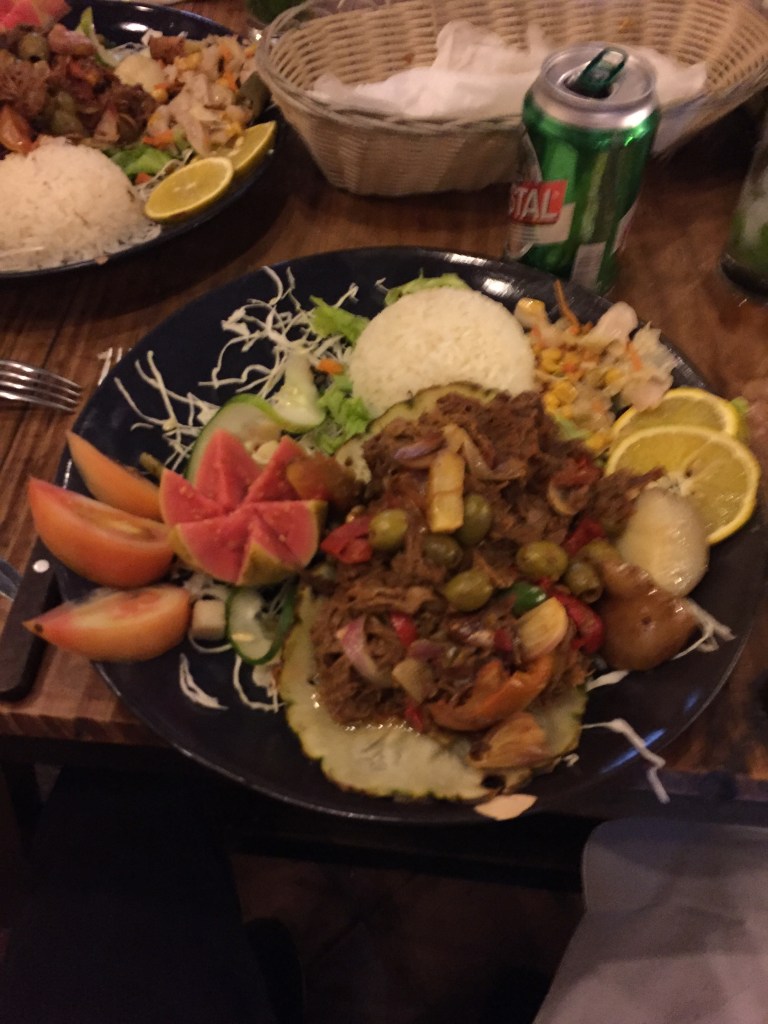
The food is really what makes this restaurant so special. While it is of course more expensive than the rest of Cuba that i visited, being that it caters mostly to tourists, the food is well worth the price. I ordered the ropa vieja, which translates oddly to shredded beef. I was presented with a wonderful dish of rich flavourful beef, on a bed of pineapple, accompanied by rice, and an assortment of fresh local fruits and vegetables. The food was sumptuous, and accompanied by the entertainment, it was one of my most enjoyable evenings of my whole trip, and a I place I would highly recommend.
Cubita Santander
This restaurant lies a few minutes walk south of Plaza Mayor, along a quiet cobbled street. It is a restaurant that serves almost exlcusively tourists, and from what I experienced, mostly English and German tourists. The walls of restaurants are covered in crayon writings of patrons of the past who have left either a funny remark, a witty quip or thanks to the restaurant owners and staff. I myself added to the abundance of writing, as did almost everyone who ate there.
Being a restaurant that relies on the patronage of tourists, it was much more expensive than any traveller would want, but this was the theme of Trinidad, a city that visually remained in the past, but in reality was a modern in its desire for tourism as any other. There was a wonderful duet of a mother and daughter who played an array of hauntingly beautiful songs and was the reason I so enjoyed that evening.
Cubita Santander is a restaurant you could easily replace with another similar Trinidadian restaurant, but it’s colourful walls and the performance that you may experience makes it worth a visit if you have spare cash and spare time.
La Cueva
La Cueva is the only major club in Trinidad, and it is incredibly unique for one important reason, it is inside a cave. The entrance to club is, as expected, the entrance to the cave itself. As you descend into the inner caverns you are immediately hit by a wave of cold air, at least 5-10 degrees colder then the humid air outside. The dancefloor is situated in the central cavern and is surrounded by giant stalagtites and stalagmites, a true sight to behold.
Unfortunately, once the amazement of the cave itself has worn off, you may come to the realisation that the club itself is actually very good. The music choice is pretty terrible and the dancefloor area much too vast to host the crowd that was there. The potential for an incredible clubbing experience is there, it just needs to be achieved.
Homemade Bars
The best part of Trinidad’s nightlife would have to be the small bars that protrude from the houses of locals that live on the long winding road up to La Cueva. The locals who serve the drinks are some of the friendliest Cubans I had the fortune of meeting. Half of the experience was talking in the limited Spanish I could to them, and sharing a rum and coke on their porch. This was one of the highlights of my time in Trinidad, and vastly outweighed the club La Cueva itself.
 A South American Synopsis